
Kinaesthetic learners absorb information best through active, “hands-on” experiences. Children naturally prefer learning by doing, and engaging their whole body helps them assimilate knowledge more effectively. Teachers should design purposeful, interactive movement activities that engage the entire class, not just kinaesthetic learners. While some educators avoid movement for fear of misbehaviour or noise, integrating it consistently becomes easier and more rewarding over time. After all, children learn through play and movement—it’s a fundamental human need.
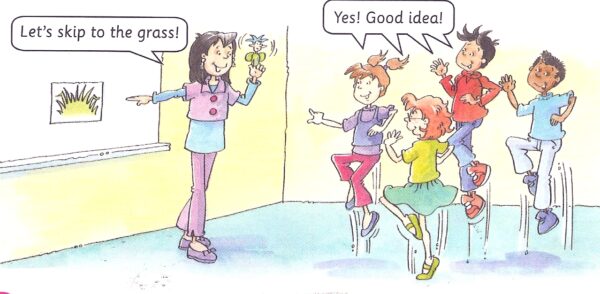
Kinaesthetic activities also enhance comprehension. When students are provided with the necessary resources, they process information quickly and retain knowledge efficiently by physically performing tasks. Simple activities such as miming actions help students associate words, sounds, and meaning. Dance and rhythmic movement, often paired with music, create a joyful atmosphere that improves both engagement and memory recall.
Benefits of Movement in Learning
Movement directly supports learning by enhancing brain function and refocusing attention. Studies show that after active motor play, children are more attentive than after long periods of sitting. Teachers can incorporate quick movement breaks spontaneously — for example: “Can everyone stand up and dance like the elf in our story?”
Movement also strengthens episodic memory, the ability to consciously recall specific past events. Students remember language learned during activities—“the verb I learned while standing in a circle.” It provides opportunities for implicit learning, which often happens through movement, emotions, and life experiences, rather than through explicit instruction like reading or worksheets. Movement-based activities make learning fun, social, and emotionally engaging.
Practical Classroom Activities
Puppets. Puppets stimulate children’s imagination, allowing them to create and explore fascinating worlds. Students enthusiastically participate in interactions involving puppets, making lessons memorable.
Miming and Gestures. Miming (charades, pantomimes, guessing games) is excellent for practicing vocabulary, grammar, and sentence structures. These activities develop listening and speaking skills through total physical response (TPR). Examples include “Listen and Draw,” “Act Out a Story,” “Simon Says,” or “Mirror the Word.”
Drama and Role Play. Drama involves the whole body and mind in a fictional context, engaging multiple intelligences (Gardner, 1985). As a multi-sensory, emotional experience, drama enhances memory and recall while making learning enjoyable.
Ball Games. Ball games can be used to practice language by starting classes with fun, interactive drills. Questions, vocabulary, or verb tense practice can be integrated into competitive or cooperative games.
Circle Games and Change Places. Circle games involve the entire class, either sitting or standing, and help recycle vocabulary and grammar structures. “Change Places” requires students to switch spots based on target vocabulary, keeping them physically active while learning.
Responding Physically. Activities such as giving thumbs up or down for agreement, or forming inner and outer circles to ask questions, increase engagement and reinforce learning through movement.
Cut-and-Paste Activities. Manipulating concepts hands-on—matching synonyms, antonyms, or adding prefixes/suffixes—works across ages and combines movement with cognitive processing.
Conclusion
Kinaesthetic activities provide dynamic, engaging learning experiences that foster deeper understanding of the English language. By thoughtfully incorporating movement, music, drama, and hands-on tasks, teachers can create lively classrooms where students are motivated, attentive, and better able to retain knowledge.
References
● Benefits of kinesthetic learning. Nepean Tutoring. nepeantutoring.com.au/benefits-of-kinesthetic-learning/
● Kuczala, M. (2015, June). The kinesthetic classroom: Teaching and learning through movement [Conference presentation]. SHAPE America National Convention.
● Maley, A., & Duff, A. (1991). Drama techniques in language teaching (pp. 122–124). Cambridge University Press.
● Gardner, H. (1985). The mind’s new science. Basic Books.
● Vernon, S. (2015). Teaching English through drama. Teaching English Games.
● Case, A. (2014). Using ball games to teach English. UsingEnglish.com. www.usingenglish.com/articles/using-ball-games-to-teach-english.html
● McKee, K. (2014). The vocab games: Flyswatter. kennycmckee.com/the-vocab-games-flyswatter/
● Sprenger, M. (2014). Vocab rehab: How do I teach vocabulary effectively with limited time? (p. 25). ASCD.
● Himmele, P., & Himmele, W. (2011). Total participation techniques (pp. 49–78). ASCD.
Trebuie să fii autentificat pentru a publica un comentariu.